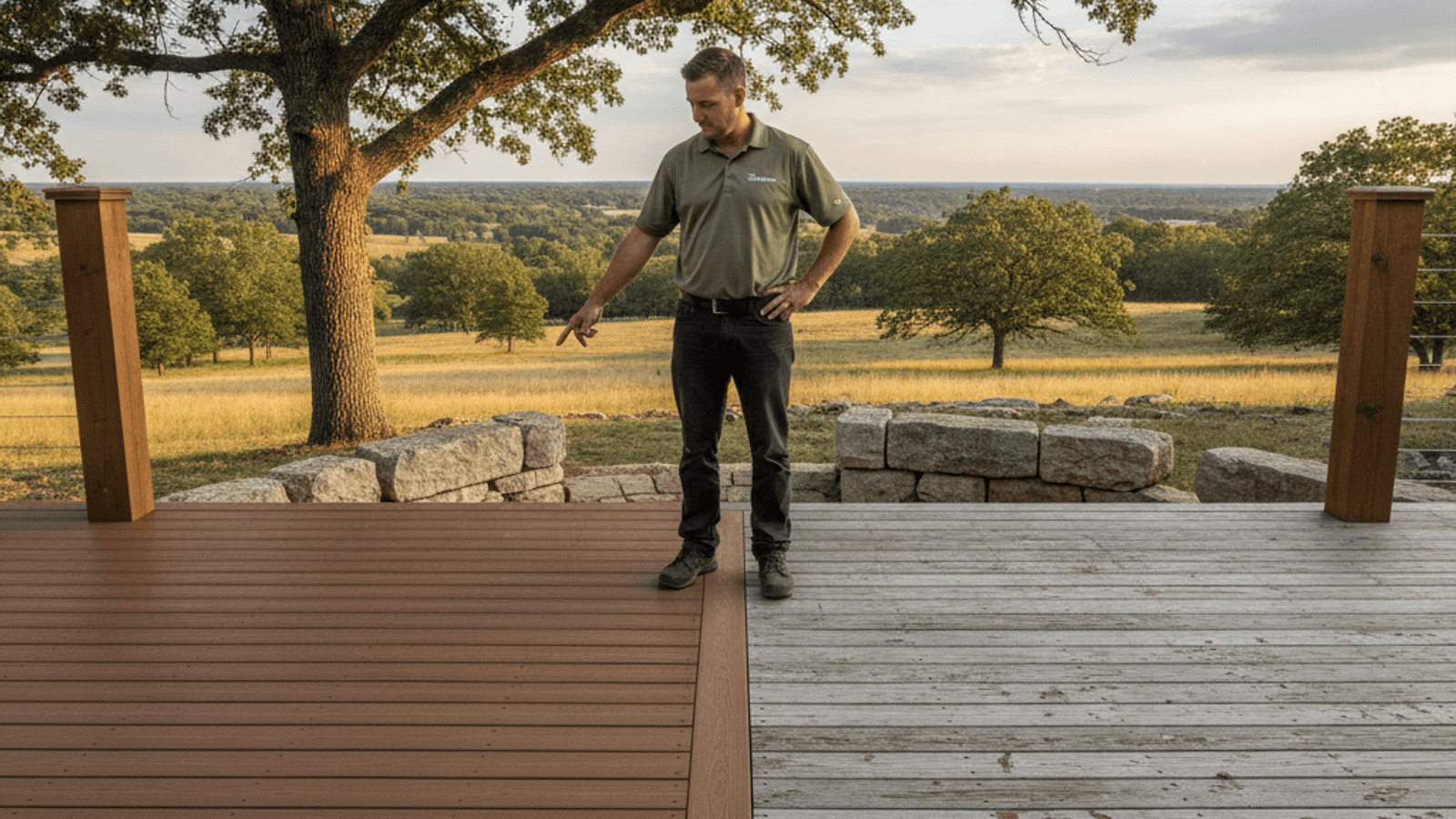
The composite-versus-wood deck question comes down to a trade: pay more upfront for less maintenance, or pay less upfront and commit to a maintenance schedule for as long as you own the deck. In a climate with real freeze-thaw cycling like Greater Topeka’s, that maintenance schedule is more demanding than it would be somewhere milder, which changes the math.
What freeze-thaw actually does to wood decking
Wood is porous, and it absorbs moisture. When that moisture freezes inside the wood fibers, it expands, which stresses the wood’s structure at a microscopic level. Do that repeatedly across a Kansas winter, then follow it with a hot, humid summer that dries the wood back out, and you get a cycle of expansion and contraction that accelerates checking, splintering, and eventually decay, especially at joints, fastener points, and anywhere water can pool instead of shedding off.
A well-maintained wood deck, meaning sealed or stained on a regular schedule, can hold up fine for many years. The catch is “regular schedule” usually means every one to three years here, not the five-plus years you might get away with in a drier or milder climate.
What composite decking changes
Composite decking is engineered from a mix of wood fiber and plastic, which makes it far less susceptible to the moisture absorption that drives wood’s freeze-thaw problems. It doesn’t need staining or sealing, and it resists splintering, warping, and rot in a way natural wood simply can’t match.
The tradeoff is cost. Composite decking material runs meaningfully higher than pressure-treated lumber, sometimes by a significant margin depending on the brand and style. The framing underneath still needs to be built correctly, including footings set below the frost line regardless of which decking material sits on top.
Running the actual math
Here’s the comparison that matters more than sticker price alone: a wood deck’s total cost of ownership includes not just the build but every staining cycle for as long as you keep the deck, plus the labor or time cost of doing it. Composite’s higher upfront cost is a one-time expense with no ongoing staining cycle, though deck repair and staining is still occasionally needed for structural issues even with composite, since the framing underneath is typically still wood.
Over a 10 to 15 year ownership horizon, composite often comes out ahead financially once you factor in the cumulative cost of staining a wood deck properly and consistently, which is a big “if” for a lot of homeowners who mean to keep up with it and don’t.
Which one is the right call
If you want the lowest possible upfront cost and are genuinely committed to a staining schedule, wood is a reasonable choice. If you’d rather pay more once and be done with the maintenance conversation, composite is built for exactly that. Either way, the framing and footings underneath matter more to the deck’s long-term structural health than which decking material sits on top.