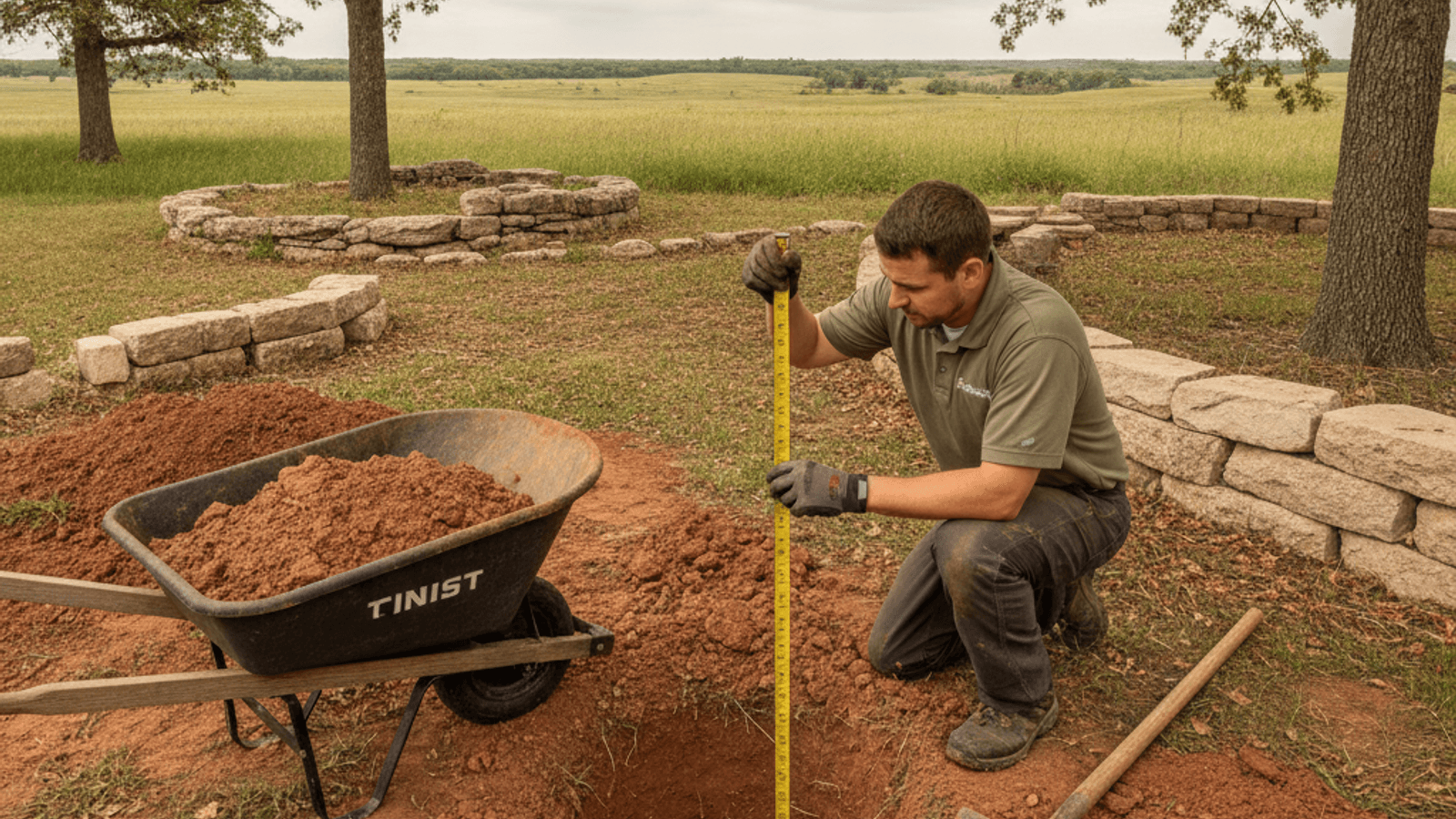
Every year, someone in Greater Topeka calls about a leaning pergola post or a deck that’s pulled away from the house, and the cause traces back to the same thing: a footing that never went deep enough. It’s the single most repeatable mistake in outdoor construction here, and it’s also the easiest to avoid if you know the number before you dig.
Why frost depth matters more than it looks like it should
Northeast Kansas freezes and thaws repeatedly through the winter, not once and done. Water in the soil expands when it freezes, and that expansion pushes upward against anything sitting above it, including a concrete footing. If the bottom of that footing sits above the frost line, the ground beneath it freezes and thaws right along with the footing, and the footing moves with it. Do that enough winters in a row and a post that started out plumb ends up leaning, a deck ledger board starts separating from the house, or a paver patio base heaves unevenly.
The number: 36 inches, minimum
For any structure with vertical posts, think pergola, gazebo, deck, or pavilion, the standard advice for this part of Kansas is a footing depth of at least 36 inches. That’s deep enough to sit below where the ground actually freezes in a normal winter, though a harder freeze or unusually wet soil can push that number higher depending on the site.
This isn’t a nationwide constant. A contractor working off a template built for a milder climate, or one who’s never built here before, might quote a shallower footing because that’s what worked somewhere else. It won’t work here, or it’ll work for a season or two before it doesn’t.
What a proper footing actually looks like
A correctly built footing for this climate isn’t just a deep hole filled with concrete. It typically includes a footing diameter sized to the load it’s carrying, a base that’s been tamped or otherwise stabilized before the pour, and in some cases a bell-shaped or flared bottom that resists the upward push of frost heave even more than a straight column would. Post-to-footing hardware, rated brackets that anchor the post to the concrete rather than just setting the post directly in it, adds another layer of stability, especially relevant given how often Kansas sees straight-line wind and severe spring storms.
Signs your existing structure has a footing problem
A few things point to a footing that was never built deep enough in the first place: a post that’s visibly out of plumb when it wasn’t originally, a deck or porch that’s pulling away from the house at the ledger board, cracking or separation where a structure meets a patio slab, or a gate or door on the structure that used to close cleanly and no longer does. None of these are cosmetic. They’re the structure telling you the ground underneath it moved and the footing moved with it.
What this means for a new project
If you’re planning a pergola, deck, or any other posted structure, ask directly what footing depth the contractor is planning and why. A contractor who’s built for Kansas conditions before will have a specific answer, not a shrug. It’s also worth asking whether they’re using post-to-footing hardware or just setting posts in concrete, since that detail matters as much for wind resistance as the footing depth matters for frost.
Retaining walls face a related but distinct version of this problem: retaining wall footings have to account for both frost depth and the pressure of expansive clay soil pushing against the wall face, which is its own engineering question separate from a post footing.
Getting the footing right costs more upfront than skipping it, but it’s the difference between a structure that’s still solid in ten years and one that needs to be torn out and rebuilt in three.