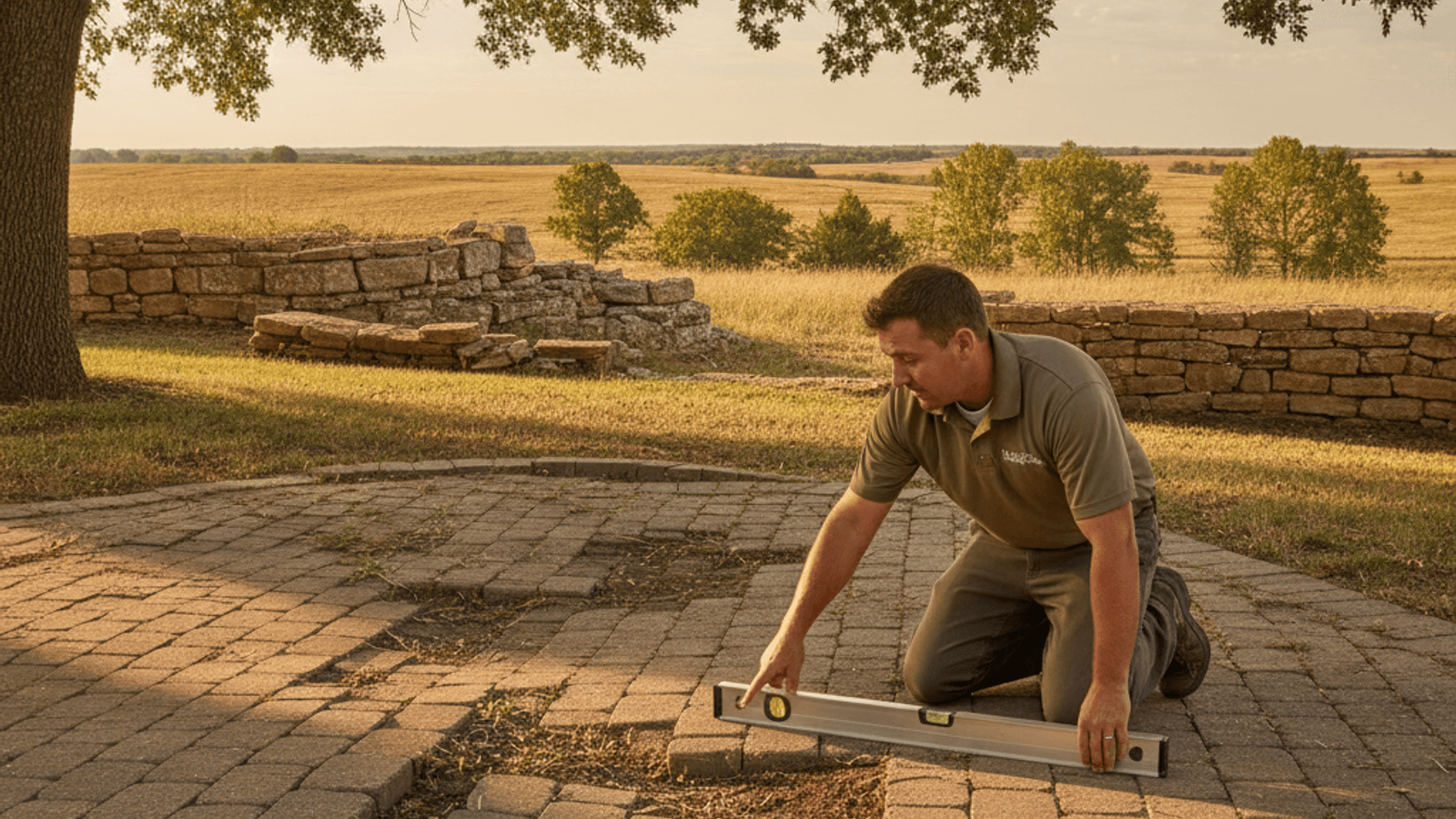
A paver patio that’s shifting, sinking in spots, or growing gaps between joints isn’t just a cosmetic problem, it’s the base underneath telling you something failed. In Greater Topeka, that failure almost always traces back to one of three causes, and figuring out which one you’re dealing with determines whether the fix is simple or a full rebuild.
Cause one: the base was never compacted properly
A paver patio depends entirely on a properly compacted aggregate base underneath it. If that base was under-compacted during the original install, whether from rushing the job or using the wrong equipment, it settles unevenly over time under the weight of the pavers and normal foot traffic. This shows up as low spots, sinking in specific areas rather than uniformly, and pavers that rock or shift when you step on them.
This is the most common cause we see, and it’s also the one that’s hardest to fix without pulling up the affected section and rebuilding the base correctly.
Cause two: expansive clay soil movement
Northeast Kansas sits on clay-heavy soil that swells when it absorbs moisture and shrinks as it dries out. That movement happens underneath the base, not just at the surface, which means even a well-compacted base can shift if the soil beneath it is moving significantly with the seasons. This tends to show up as broader, more uniform heaving across a wider area rather than isolated low spots, and it often correlates with drainage problems nearby, since standing water feeds the soil’s moisture swings.
Cause three: freeze-thaw heave
Water that gets into the base material, whether from poor drainage or simple rain infiltration, freezes and expands through the winter. That expansion pushes the base and the pavers above it upward, and when it thaws, everything doesn’t necessarily settle back to exactly where it started. Repeated over several winters, this creates a slow but real drift in how level the patio surface is.
How to tell which one you have
Isolated sinking in one or two spots usually points to base compaction. Broad, gradual heaving across the whole patio, especially paired with cracks in nearby concrete or fence posts leaning, points to clay soil movement. Seasonal changes, worse in late winter and early spring, point to freeze-thaw.
What the fix actually involves
A minor case, a few pavers slightly uneven, can sometimes be addressed by pulling those specific pavers, adding or removing bedding sand to relevel, and resetting them. A more significant case, where a larger section has shifted or the base itself has failed, usually means removing the affected pavers, correcting the base (including drainage improvements if water management is part of the problem), and resetting.
What doesn’t work is ignoring it. A shifting patio gets worse each freeze-thaw cycle, not better, and the longer it goes unaddressed, the more of the patio ends up needing to be rebuilt rather than repaired.